
The UK Sustainability Reporting Standards (UK SRS) were published by the Department for Business and Trade on 25 February 2026. The Financial Conduct Authority Listing Rules consultation closed on 20 March 2026. Final rules are expected in autumn 2026, and mandatory climate disclosures under UK SRS S2 will begin for accounting periods from 1 January 2027, with first reports to be filed in 2028.
What Was Published
The DBT published two endorsed standards based on the International Sustainability Standards Board's (ISSB) IFRS S1 and S2:
- UK SRS S1: General requirements for sustainability-related financial disclosures across all material topics (workforce, biodiversity, water, supply chain).
- UK SRS S2: Climate-related disclosures including governance, strategy, risk management, scenario analysis, transition plans, and Scope 1, 2, and 3 greenhouse gas (GHG) emissions.
Both standards are immediately available for voluntary use. UK SRS S2 is confirmed as a national reporting framework under section 414CB of the Companies Act 2006 (CA 2006), with section 463 liability protections applying to Strategic Report disclosures.
SECR vs UK SRS vs ESOS: How They Fit Together
UK SRS does not replace the Streamlined Energy and Carbon Reporting (SECR) or the Energy Savings Opportunity Scheme (ESOS). All three remain in force, but each reports to a different reader. SECR sits in the Directors' Report and is read by stakeholders mainly. ESOS goes to the Environment Agency every four years as an energy audit submission. UK SRS sits in the Strategic Report section and is written for investors. The data underneath the three reports largely overlap. The audiences, timing, and assurance expectations do not.
| Category | SECR | UK SRS | ESOS |
| Legal basis | The Companies (Directors’ Report) and Limited Liability Partnerships (Energy and Carbon Report) Regulations 2018 (amending Companies Act 2006) | UK SRS S1, S2; Financial Conduct Authority Listing Rules (CP26/5). Alongside it, the Companies Act 2006 (especially sections 414CA and 414CB) | The Energy Savings Opportunity Scheme Regulations 2014 |
| Introduced | 2019 | 2026 | 2014 |
| In scope | Large UK companies + all quoted companies | ~515 primary-listed companies (initially) | Large UK undertakings |
| Reports | UK energy use, Scope 1 + 2 GHG, intensity ratio | Climate (S2) + general sustainability (S1) | Energy audit + action plan + progress |
| Frequency | Annual | Annual | Four-year cycles (Phase 4 due 5 Dec 2027) |
| Filed in | Directors' Report | Strategic Report / Financial Statements | Notification to the Environment Agency |
| Audience | General stakeholders | Investors | Government regulator |
| Regulator | Companies House / Financial Reporting Council (FRC) | Financial Conduct Authority | Environment Agency |
Most large UK-listed companies will fall within the scope of all three regimes from 2027. A FTSE 100 manufacturer, for example, would face ESOS Phase 4 compliance notification by 5 December 2027, SECR reporting in the Directors' Report, and UK SRS S2 in the Strategic Report. While the data foundation is shared, the intended users, reporting frequency, and assurance expectations differ across each framework. UK SRS can represent an investor-grade overlay on the existing energy and carbon reporting obligations, not a replacement for them.
The SRS Timeline
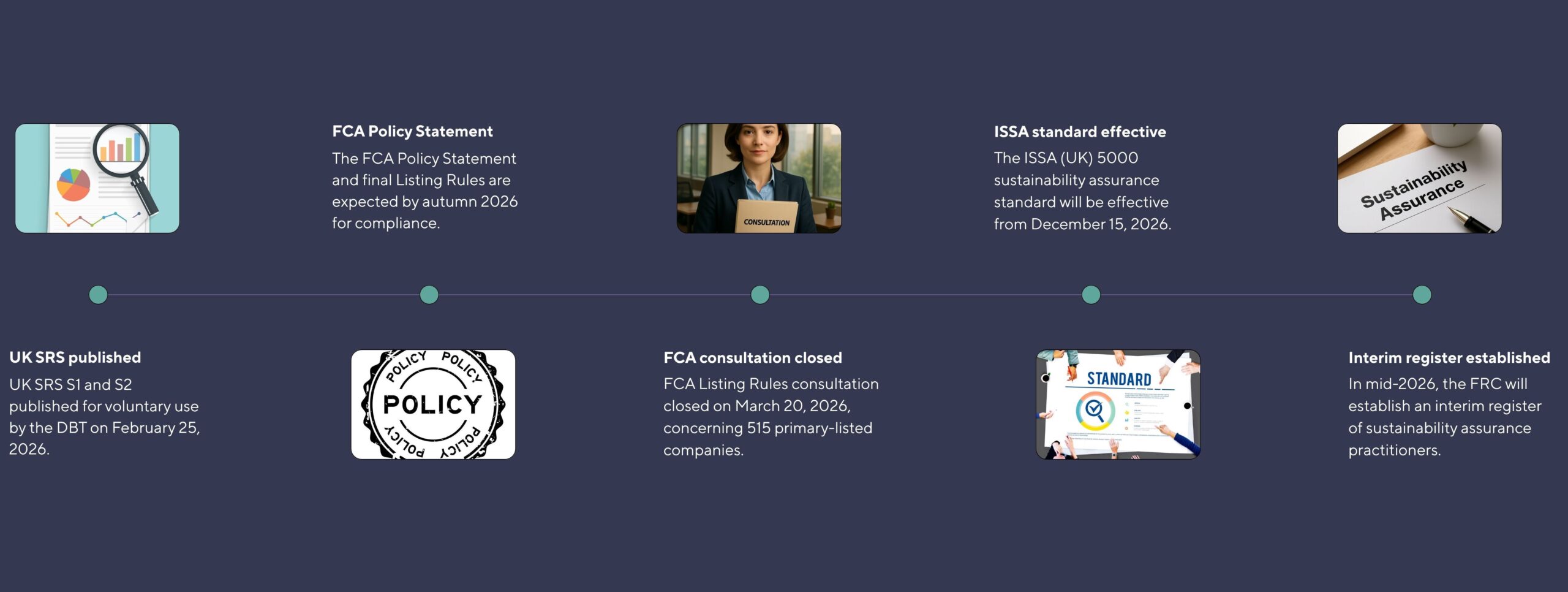
Additionally, under the Financial Conduct Authority's CP26/5 proposals, targeting approximately 515 primary-listed companies:
- Now: Voluntary use available
- 1 January 2027: UK SRS S2 (climate) mandatory for in-scope listed companies
- 1 January 2028: Scope 3 emissions on comply-or-explain (1-year transitional relief)
- 1 January 2029: UK SRS S1 (general sustainability) on comply-or-explain (2-year transitional relief)
First UK SRS-aligned annual reports are expected in 2028, covering the 2027 financial year.
Four UK-Specific Amendments
The UK SRS depart from the ISSB baseline in four targeted ways:
- Sustainability Accounting Standards Board (SASB) and Industry-based Guidance are optional ("may" rather than "shall").
- No fixed effective date set by legislation, Financial Conduct Authority rules, or other regulation.
- Sustainability disclosures must be reported simultaneously with financial statements the IFRS S1 deferral option is removed.
- Financed emissions explanation requirement (paragraph B59A) added, plus ISSB's December 2025 amendments (removal of the Global Industry Classification Standard (GICS) requirement, derivatives excluded from Scope 3 Category 15).
Assurance Regime
The Financial Reporting Council will establish an interim register of sustainability assurance practitioners by mid-2026, with ISSA (UK) 5000 as the relevant assurance standard, effective for periods beginning on or after 15 December 2026. The Financial Reporting Council's role here is interim. Its planned successor, the Audit, Reporting and Governance Authority (ARGA), will take over as the permanent regulator once it is formally established in legislation.
The Financial Conduct Authority's CP26/5 consultation does not propose mandatory assurance in the first reporting year. The mechanism is disclose-what-you-did: while assurance is not yet mandated, companies will be required to disclose whether sustainability information has been assured, who provided the assurance, and at what level. This is the same architecture used for transition plans under UK SRS S2, which discloses the absence rather than mandates the presence.
How can iCOR support organisations with UK SRS?
iCOR helps organisations to reduce reliance on spreadsheets, save time, and feel more confident about legal and operational risk and legal compliance. The platform includes a self-audit tool that maps applicable environmental, health, and safety legislation into a tailored legal register, including the legal obligations of both SECR and ESOS, and allows you to track compliance actions, assign responsibilities, and present your progress.
Book a demo here to learn how iCOR can help you with UK SRS, turning compliance into an integrated and continuous process that is accessible to everyone.