
The Science-Based Targets initiative (SBTi) is in its most significant transition since launch. With V2 of the Corporate Net-Zero Standard expected in mid-to-late 2026 and mandatory from January 2028, sustainability teams are operating across two regimes at once. Here is what climate strategists need to know.
SBTi by the Numbers
Over 11,000 companies and financial institutions have set or committed to science-based targets around 25% of global revenue and 40% of global market cap. Net-zero pledges cover 92% of global GDP and 88% of global emissions. Corporate target-setting was up 40% in 2025, with Asia emerging as a new centre of gravity.
Corporate Net-Zero Standard V2: The Transition Timeline
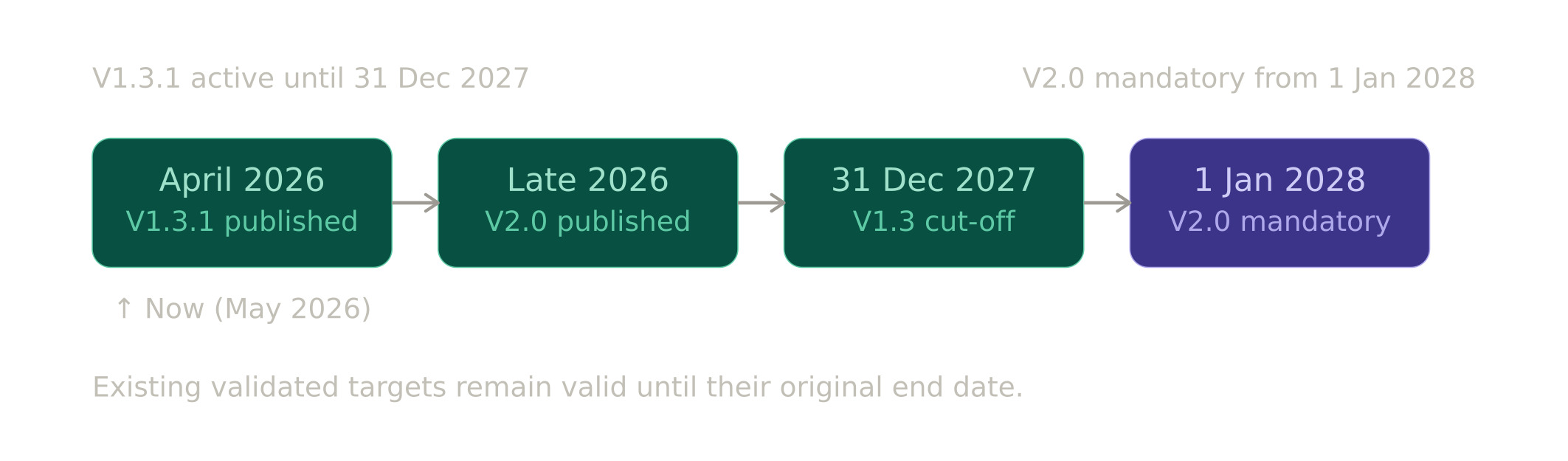
The current framework remains valid, but the runway is finite:
V1.3.1 was published in April 2026, incorporating the updated Absolute Contraction Approach (ACA). Targets validated under V1.3.1 will form a credible foundation for V2 alignment.
What's Changing in V2
Four shifts will materially affect target setting and ongoing reporting:
- Ongoing Emissions Responsibility (OER) Framework. Replaces "Beyond Value Chain Mitigation." Voluntary until 2035, then mandatory for Category A companies (large firms in high-income countries) at a percentage that scales linearly to 100% by the company's net-zero year. Two recognition tiers, Recognised and Leadership, formally embed carbon credits into the net-zero strategy for the first time.
- Mandatory 100% low-carbon electricity by 2040. A new mandatory Scope 2 electricity target requires sourcing from the same market as consumption, with hourly matching phased in. This is a step-change in renewable PPA and EAC strategy.
- Transition plans within 12 months. Category A companies must publish credible transition plans within 12 months of target validation and begin addressing residual emissions through removals from 2035.
- Updated ACA methodology. The 29 April 2026 revision adjusts annual reduction rates based on time remaining to the net-zero deadline. The 4.2% minimum annual reduction floor and 2050-or-earlier net-zero deadline remain. Validation Portal tools apply the calculation automatically.
Other 2026 Updates Worth Tracking
FLAG Guidance V1.2 Effective 19 March 2026
The first substantive revision to Forest, Land and Agriculture target-setting since it became mandatory in April 2023. Effective immediately, with no transition period. The five changes that matter:
- The 6-month grace period is gone. Companies with non-FLAG SBTs must now set FLAG targets by their mandatory five-year review, not within six months of the GHG Protocol Land Sector and Removals Standard.
- Seven commodities are mandatory under no-deforestation: cattle, cocoa, coffee, oil palm, rubber, soy, and timber. Coffee and rubber are new, aligning with the EU Deforestation Regulation.
- 2025 no-deforestation deadline removed. New submitters get up to 2 years post-validation, with a hard backstop of 31 December 2030.
- 12 months to publish no-deforestation documentation after target validation.
- Mandatory alignment with the GHG Protocol Land Sector and Removals Standard V1.0 (January 2026), now the accounting backbone for FLAG.
Applies to companies in Forest & Paper Products, Food Production, Food & Beverage Processing, Food & Staples Retailing, Tobacco, or any company where FLAG emissions exceed 20% of total Scope 1+2+3.
Automotive Sector Net-Zero Standard, Final Expected Q3 2026
Second consultation ran from 3 February to 22 March 2026, alongside pilot testing. Final publication is expected no earlier than Q3 2026, with a 6-month grace period before mandatory adoption for automakers and parts manufacturers. It will replace the automotive portion of the Land Transport Guidance and be interoperable with Corporate Net-Zero Standard V2.
Key features of the second draft:
- Scope 3 Category 11 (use of sold products) is the centre of gravity, 70–80% of an automaker's footprint
- Low-emission vehicles redefined as zero-emission vehicles (ZEVs), stricter than the prior LEV definition
- Optional ZEV sales-share metric as an alternative to absolute emissions targets
- Extended the convergence date to reflect regional infrastructure and technology differences
- Global aggregated targets permitted for light-duty vehicles to streamline implementation
For UK automotive OEMs and tier-1/tier-2 suppliers, Q3 2026 publication is the planning horizon; capital decisions on EV platforms, battery sourcing, and supplier engagement should anticipate the new criteria.
Double-Claiming Rules in V2
The V2 draft proposes that removals used for neutralisation cannot simultaneously be claimed against a country's Nationally Determined Contribution (NDC). This would render certain credits ineligible, including EU Carbon Removals and Carbon Farming (CRCF) credits and state-supported BECCS projects in Denmark and Sweden, significantly reshaping the eligible removals market.
What Sustainability Teams Should Do Now
- Validate or refresh near-term targets under V1.3.1 before the 31 December 2027 deadline.
- Map your Category A status and start scoping a 12-month transition plan workflow.
- Build the data backbone for hourly-matched low-carbon electricity reporting ahead of the 2040 deadline.
- Review carbon credit and removals strategy under the OER framework, especially for Leadership tier eligibility.
- Track sector-specific standards if you're in automotive, FLAG, or financial services.
